Thursday, January 31, 2008

Internet cable cut causing network slowdown

Internet cable cut causing a massive network slowdown


Internet services have broken down across parts of the Middle East and India, due to damage of an undersea cable in the Mediterranean. Egypt’s Telecommunications Ministry claims the damage caused disruption to around 70% of the country’s internet network. The ministry says it has no knowledge of how the cable was cut, but that service would probably take several days to return to normal.

India has also reported serious disruptions to its services, claiming to have lost around half of its capacity. One Indian ISP is already linking the problem to the Egyptian outage.

“There has been a cable cut on several cable systems in Alexandria, Egypt which has impacted internet connectivity in India,” says Videsh Sanchar Nigam Ltd (VSNL), an internet service provider.

VSNL says its service has been “largely restored” by diverting to another cable. However, a spokesperson for India’s ISPs says the country is likely to receive a “degraded” service for the next 10 to 15 days, while repairs are underway.

Disruptions have also been reported in the United Arab Emirates, Kuwait and Saudi Arabia.

8

NEW DELHI — Two undersea telecommunication cables were cut on Tuesday evening, knocking out Internet access to much of Egypt, disrupting the world’s back office in India and slowing down service for some Verizon customers.

One cable was damaged near Alexandria, Egypt, and the other in the waters off Marseille, France, telecommunications operators said. The two cables, which are separately managed and operated, were damaged within hours of each other. Damage to undersea cables, while rare, can result from movement of geologic faults or possibly from the dragging anchor of a ship.

Hundreds of undersea cables often owned and managed by international consortiums keep telecommunications running worldwide. A surge in phones and Internet connections in Asia and to new financial hubs like Dubai has increased traffic on many of these cables.

Most disrupted communications were quickly rerouted through other cables.

“Some of our customers were impacted” by the damaged cables on Wednesday morning until the company rerouted traffic, said Linda Laughlin, a spokeswoman for Verizon. The company is building a trans-Pacific cable from Oregon to China, South Korea and Taiwan because it needs more capacity in Asia, she said.

A trade group in India estimated that roughly 60 percent of the country’s Internet users were affected, but many large companies switched quickly to backup plans, and business was not significantly disrupted. India is the primary customer service center for many American and European financial services companies, and Indian companies handle back-office operations for many of the world’s largest corporations.

“In some way or another every company took a hit,” said R S Parihar, an executive with the Internet Services Provider’s Association in India. Internet traffic heading east from India was disrupted, and many companies rerouted their Internet traffic to the west instead, he said.

“In the case where people had only one route they were in trouble,” said Mr. Parihar. Smaller companies, or those that did all their business with countries east of India, were the most affected, he said.

One of the affected cables stretches from France through the Mediterranean and Red Seas, then around India to Singapore. Known as Sea Me We 4, the cable is owned by 16 telecommunications companies along its route.

The second cable, known as the Flag (for Fiber-optic Link Around the Globe) System, runs from Britain to Japan.

Ashutosh Sharma, a spokesman for Bharti Communications, one of India’s largest telecommunications companies, said the company had “taken significant steps to ensure that services are available by routing traffic through alternative paths.” Bharti was working closely with the cable operators to “restore normalcy as soon as possible,” he said.

Seo Updates

Tuesday, January 29, 2008

Google Adsense Tips Tricks Secrets

I’ve been reading a few forums and blogs about Google Adsense tips lately, and thought it would be helpful to consolidate as many as possible in one place without the comments. I’ve also thrown in a few tips of my own. We start out with some of the basic general stuff and move to the more specific topics later on.

Build an Empire?

When you’re deciding to become a website publisher you will fall into one of two broad categories:

  • Publish 100 websites that each earn $1 a day profit
  • Publish 1 website that earns $100 a day profit

The reality of it is, most people end up somewhere in between. Having 100 websites leaves you with maintenance, management and content issues. Having one website leaves you open to all sort of fluctuations (search engines algorithm’s, market trends, etc). You can adapt your plan on the way, but you’ll have an easier time if you start out going in the direction of where you want to end up.

General or Niche

You can build your website around general topics or niche ones. Generally speaking niche websites work better with adsense. First off the ad targeting is much better. Secondly as you have a narrow focus your writing naturally becomes more expert in nature. Hopefully this makes you more authority in your field.

If this is your first try at building an adsense website, make it about something you enjoy. It will make the process much easier and less painful to accomplish. You should however make sure that your topic has enough of an ad inventory and the payout is at a level you are comfortable with. You may love medieval folk dancing, but the pool of advertisers for that subject is very small (in fact it’s currently zero).

Once you’ve gotten the hang of how Adsense works on a website, you are going to want to dabble in some high paying keywords, you may even be tempted to buy a high paying keyword list. This does come with some dangers. First off the level of fraud is much higher on the big money terms. Secondly there is a distortion of the supply and demand relationship for these terms. Everyone wants ads on their website that make $35 or more a click, however the number of advertisers who are willing to pay that much is pretty limited. Additionally the competition for that traffic is going to be stiff. So, don’t try to run with the big dogs if you can’t keep up. If you have to ask if you’re a big dog, then chances are, you’re not. I have used a high dollar keywords report from cashkeywords.com and was pleased with my results (see cash keywords free offer recap).

New Sites, Files and Maintenance

When you’re building a new site don’t put adsense on it until it’s finished. In fact I’d go even farther and say don’t put adsense on it until you have built inbound links and started getting traffic. If you put up a website with “lorem ipsum” dummy or placeholder text, your adsense ads will almost certainly be off topic. This is often true for new files on existing websites, especially if the topic is new or different. It may take days or weeks for google’s media bot to come back to your page and get the ads properly targeted. TIP: If you start getting lots of traffic from a variety of IP’s you will speed this process up dramatically.

I like to build my sites using include files. I put the header, footer and navigation in common files. It makes it much easier to maintain and manage. I also like to put my adsense code in include files. If I want/need to change my adsense code, it’s only one file I have to work with. TIP: I also use programming to turn the adsense on or off. I can change one global variable to true or false and my adsense ads will appear or disappear.

Managing URL’s and channels

Adsense channels is one area where it’s really easy to go overboard with stats. You can set up URL channels to compare how one website is doing to another. You can also set up sub channels for each URL. If you wanted to you do something channels like this:

  • domain1.com - 728 banner
  • domain1.com - 336 block
  • domain1.com - text link
  • domain2.com - 728 banner
  • domain2.com - image banner
  • domain2.com - 336 block
  • domain3.com - 300 block

While this is great for testing and knowing who clicks where and why, it makes your reporting a little wonky. Your total number will always be correct but when you look at your reports with a channel break down things will get displayed multiple times and not add up to correct total. Makes things pretty confusing, so decide if you really need/want that level of reporting detail. TIP: At the very least you want to know what URL is generating the income so be sure to enter distinct URL channels.

Site Design and Integration


Experiment with multiple ad formats and locations

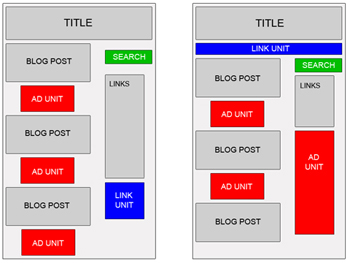
In general, wider ad formats tend to be more reader-friendly. Placing an ad unit after the first post will likely catch your readers' attention. Take a look at our sample implementations to get some ideas. Also, consider placing a Skyscraper (120x600) or vertical link unit on the right side of your blog. If you're using Blogger, you can find instructions on placing AdSense code in your blog's sidebar.

Offer readers more options with search and referrals

To make sure you're earning the most revenue possible with AdSense, go beyond just ads to use AdSense for search and referrals. You can increase your earnings, provide readers with valuable information, and take advantage of flexible formats.

Improve ad targeting

With section targeting, you can target an ad unit to a specific section of your blog, as well as block out irrelevant sections like navigational links. We recommend that only those familiar with HTML attempt to implement section targeting.

Tip for generating more traffic to your blog: If you're a Blogger user, activate this setting to notify Weblogs.com, a blog update notification service, whenever you have updated your blog. That means your blog will be included in various "recently updated" lists on the web as well as other blog-related services.

Seo Updates

Mistakes Search Marketing Firms Make

1. Charging a “Set-up” Fee.


Let’s start with the biggest business mistake search marketing firms make;
pricing their services. I can’t tell you how many SEO/M firms I see that
still have the following pricing model - $X,000 for set-up, then $XXX for monthly
maintenance. Yikes!


It’s not that I can’t empathize with firms that continue to offer
this model. You get a nice cash injection - before you even start work - and
the client has a low cost option to keep the service going. Unfortunately, what
actually happens is this:


a. You deter potential new clients who are not able to budget for such
a high upfront cost;

b. Those that do become clients, see the “monthly maintenance”
as an optional extra, something they often (wrongly) feel they can do without.


There are lots of alternative pricing options that work for search marketers,
but often just switching to a standard monthly payment, that remains the same
each month, can help potential new clients sign-on and create a mindset that
the service is an ongoing concern.


2. Offering Too Many Service Options


I’ve spoken with, and worked for, search marketing agencies that offer
a smorgasbord of search marketing service levels. Does this sound like your
service offerings: Light”, Entry”,
Bronze”, Gold”?, Platinum”,
Platinum Plus” etc, etc. Enough already! My head hurts
just from looking at the service names. Can you imagine how confused your prospective
clients get, when they actually have to decipher each service’s deliverables!

Seo Updates

Ideally, your firm should offer just one solution รข€“ a service
that is customized specifically to the needs of the client. If you can’t
do that, my advice is to have no more than three different service levels. The
first is the lowest cost, but will still get the job done. The second is the
middle-tier, and the one you actually expect 80% of your clients to select.
The third is the most expensive, whistles and bells, service that you only expect
a few clients to actually sign-up for.


The reason for the three levels? Here’s what will likely happen when you
speak to prospective clients. Some will like the concept of the top-tier service,
but select the middle one, due to budget constraints. Some will not have much
of a budget, but will likely size-up” to the middle-tier,
so as to not appear cheap or short-change their business. Price the middle tier
offering to be the best value for them and you.


One other, quick tip on pricing. Never discount any service without removing
some of the options from that service. I’ve worked with thousands of clients
and each time we have simply reduced the price–without reducing the service–it
devalues the service and creates a what other discounts can
I get” mentality with those clients.


3. Their Business Doesn’t Scale


I am still amazed at the number of search marketing firms that don’t want
to grow their business. Honestly, they’re quite happy to have 10 employees,
15 clients and $500,000 in annual revenue. While that’s never been my philosophy,
I respect those are their goals for their company.


That being said, you should always structure your business so it can be scaled
to just about any size–even if you do decide to stay the same size. What’s
the best way to do this? There’s no quick answer, but one rule of thumb
that I find works is this; build your business as if you planned to franchise
it. Could you take the systems and processes, you have in place, and replicate
them elsewhere. If the answer is “No”, you likely have a poor internal
structure that probably relies too much on the skills of the CEO or some other
SEM expert. (See No. 7 below).


4. They Spend More Time on New Clients Than Existing Ones


How many of you get a little annoyed when your cell phone company wheels out
great new handset deals, while you’re using a brick”
because you’re 12 months into a 24 month agreement? That’s often how
your clients feel. Ask them! Most will tell you that the service you offered
over the first couple of months was a lot better than what they now receive.
It’s no wonder that the search marketing industry has such a high attrition
rate.


Instead of purely focusing on attracting new clients, realize that you’ve
already made a huge investment into your existing clients and figure out ways
to ensure that they don’t see a drop-off in quality and attention, once
they’ve inked that 12-month deal with you.


5. They Fail to Understand a New Client’s Goals


How much time do you spend discussing a new client’s goals and expectations,
when they first retain your services? I’m not talking about what was discussed
on the sales-call; I’m referring to after they’ve signed-up. My guess
is your company, like many SEO firms, assume what the client is looking for,
or apply some cookie-cutter approach to their goals.


You should spend hours, if not days, learning everything you can about your
new client, before you start any campaign work. Don’t just take the normal
client request of “I want more traffic” or “I want to be #1 on
Google for my top keyword”. Interview the client and find out what metric,
what results truly matter to their business. What will they be looking for,
in order to deem the campaign a success? Don’t ever make assumptions, and
don’t ever accept a generalized we want more” answer.


6. They Fail to Realize Clients’ Goals Change Over Time


Speaking of understanding your new client’s goals, did you know that they
change often? Don’t assume that the goals, agreed on when the client first
retained you, are the same goals each month thereafter.


While you’re moving ahead and achieving an increase in the number of keywords
ranking on Google, your client is now fixated on why a particular page doesn’t
have a PageRank. Never assume you know your clients goals. They change and you
should ask them to reconfirm them often.


7. They Rely On One “Expert” to Provide All Client Recommendations


How many search engine experts does your firm have? Be honest. How many employees
do you have, that you would have no problem speaking on your behalf at the next
Search Engine Strategies conference?


Too many search marketing firms rely on the knowledge and skills of one in-house
expert. Often that expert is the CEO or another high-ranking executive, who’s
plugged into the industry, written articles and spoken at conferences.


Many search marketing firms never grow, because they rely on the availability
of just one expert. It’s time to realize that you cannot, and should not,
rely on one person to provide all of the deliverables. Train your people to
know as much as you, in fact, give them an opportunity to learn more than you!
You’ll gain more credibility, grow your business, empower and retain your
talented employees, while reducing the crushing burden of being the gatekeeper
of information.


8. Client Information is Silo’d


Not only is it important to constantly check your client’s goals and needs,
but you should share that information with ALL those working on a client’s
campaign.


Too often, clients have a single point of contact within their chosen SEO firm
(a campaign manager for example). While the campaign manager and the client
are both on the same page and both understand the goals of the campaign; the
poor copywriter down the hall–the one asked to come up with some compelling,
optimized copy–doesn’t have a clue what the client is looking for
or what their business objectives are.


Many search marketing agencies could kill two birds with one stone–client
success and employee retention–if they would just make sure that every
employee understands the goals of the client and how their work makes a difference
in the campaign. Client goals and desires should not be kept to just one team
member. Instead, make sure everyone on the team has a chance to hear firsthand
from the client. You’ll find their work quality improves and their satisfaction
with their job increases.


9. They Turn Speaking Engagements Into Sales Pitches”


It’s a sad fact that most “expert speakers” don’t understand
what their audience wants to hear from them. I’ve seen too many speakers
stand-up and provide the audience with high-level theories and concepts. They
then hit their audience with a double-whammy of atrocity. First, they never
actually provide solutions to the problems they’re discussing–fearful
that they’ll give away too much information. Second, they compound this
by turning the presentation into a sales-pitch for the company they represent.
Arrgh!


Want to know which speakers end-up getting a fistful of business cards at the
end of their talk? It’s the ones who’ve shared so much great advice
and information with the audience that the attendees think to themselves:


“Wow, that’s really going to help our company, but it sounds so complex
and time consuming. I know what, that guy seems to know his stuff. If he shared
that amount of information in a 20 minute presentation, imagine the amount of
info I’ll get if I hire his search marketing firm.”


10. They’re Scared of Losing Their Top Talent


If you are running a successful search marketing agency, you need to embrace
the cold fact that you will, at some point, lose one of your top employees.
Unfortunately, this paralyzes many firms as they become concerned with giving
their top employees too much information or too much training. Have you ever
asked yourself this, “Should I send “Jane” to that conference?
What if one of our competitors offers her a better job?”


There are many questions that are similar to the one above. Unfortunately,
they often prevent CEO’s from training their staff to the highest levels.
They ask all new employees to sign non-compete agreements, hoping that they’ll
be able to keep their staff on a tight leash.


If you want to grow your company, you should invest in its people. Sure, you
may end up losing some of your key people over time, but that brings us back
to the idea of not relying on one expert to deliver client recommendations.
If you create a great environment, which takes care of clients, trains its employees
and gives them an opportunity to make a difference, you’ll build a company
that your key people will want to stay with. And if they do decide it’s
time to stretch their wings, by following the advice outlined above, your company
will still remain strong due to its great client relationships, service offerings
and expert staff.

Source: http://www.marketingpilgrim.com/2006/09/top-10-business-mistakes-search.html


Monday, January 28, 2008

Search Engine Updates vs SEO

Search Engine Updates vs. SEO Updates

Webmasters always anxiously wait for a search engine update. Those who rank well want to see their sites get even better. Those who didn't do well expect a major boost. Those whose sites get de-indexed anticipate a major comeback. Those who just started new sites bet on their sites will make into the first page of search engine result pages (SERPs) for their targeting keywords. Of course, not everyone will be happy about the results of search engine updates. After all, search engine traffic is a zero-sum game - someone loses and someone gains. Then, the webmasters start preparing for next update.

The Types of Search Engine Updates

Search Engines are large software systems. There're three types of search engine updates.

  1. Updates of index database - Search engine crawlers continuously scan the Web for new content and changes to feed their index databases. This drives the minor SERP shifts.
  2. Minor search engine updates - Search engines need to fix software bugs and do some minor algorithm changes once in a while. Minor updates seem to happens monthly.
  3. Major search engine updates - Every year, major search engines will shock the SEO community with major search engine updates. A major update involves both major algorithm changes and the re-organization of the index database. Major search engine updates are clearly driven more by business reasons than by technical reasons.

The Business Reasons Behind The Major Updates

All major search engines claim that they strive to present search results to users with the highest quality. But the business of search engine is business. What they won't tell us is that there're many business reasons for every major search engine updates. Search engine traffic is hot commodity - it's free and has higher conversion rate since the searchers are very close to make their buying decisions. The downside of the search traffic for webmasters is that they don't have control at all. Your sites may be ranked #1 today, but nowhere next day.

Search engine companies will, no doubt, use the search engine traffic to maximize the values for their stakeholders. Google's Feb. 2 update (allegra update or Superbowl update) once again shocked the webmaster community like last Florida update. The noticeable change in Superbowl update is that well-established sites rank well even for specific keywords that aren't even highly relevant to their pages. You may think the move is to fight spams and improve the quality of SERPs. That's only part of the story. The results of the update is that the websites of well-established corporations (with never ending press releases) will get a major traffic boost from Google. Google does this by algorithm changes, not manual manipulations.

If we think search engine traffic from Google is really an incentive to try it free before you buy. This time, Google decides to lure the major corporations to test the benefits of search traffic. Major corporations will likely increase their spending in online advertising and those news agencies may even drop their law sues against Google if they see the traffic from Google justifies that their sites benefit from including in Google index database.

Is this the real driving force behind last update? Only Google knows. If you own Google, however, you will do the exactly the same.

Will this negatively impact the user experience? - maybe and maybe not. What is the real difference between the #1 spot and the site that ranks #100? - the backlinks. Backlinks don't alter the quality of a page at all.

When they say technology, they mean business. Major technology changes are always driven by business needs. It has nothing to do with "good" or "bad".

Strategies to Cope with search Engine Updates

The Internet and the Web was once hailed as the new medium and the new opportunity for small business and site owners. They will be disappointed as big three peek into fortune 500 companies's deep packets. There're strategies they can use to cope with the search engine updates, however.

  1. Create a portfolio of website using different SEO techniques. If some of your sites get hammered in a update the rest may benefit from the update.
  2. Generate traffic from all major search engines.
  3. Use the search traffic to build loyal user bases.
  4. Build sites similar to the sites of well-established companies. The tags, on-page, off page optimization techniques will become less and less important as major corporations aren't interested in those types of things that geek webmasters are interested.

Speculation on Coming Updates

The next Google update is around the corner. I won't expect any noticeable change. If Google decides to let big apples try search traffic free. They will need a couple of months to realize the values of the search traffic. There will be major re-distribution of search traffic in 3 or 6 months. If the same group of major corporations always get huge amount of free traffic from Google. They won't bother to open their wallets. The major traffic distribution may be from one group of major corporations to another. The search traffic will unlikely sift back to small sites.


The Impact of Brandy

These changes make for sober reading if you're a Webmaster -- to optimize your site successfully for Google has become a lot more difficult. Nevertheless, there are a number of practical steps that can be taken to promote your ranking in the short and long term.

  1. Synonyms

    As LSI appears to be so significant, it is important to start looking carefully at the information architecture of each major section of your site, and to increase the use of related words. It is also important to re-examine the title tags to include this concept; good title tags have synonyms and avoid repetition of the key phrase.


  2. Outbound Links

    Link to authority sites on your subject. In the travel insurance example, these authority sites could include places like the State department, major skiing directories, etc. Not only will this help with LSI, it also allows Google to define the neighbourhood more easily. Furthermore, you could engage in link swaps with other companies so that you gain the benefit of an on-topic, LSI-friendly link.


  3. Inbound Links and Link to Us Pages

    Based on what we have just said, sites need to formulate a link development strategy. A budget needs to be set aside to buy links and develop mini-sites. Look to set up links with university sites (.edu or ac.uk), as these seem to be valuable given Google's informational bias.

    Each section of a site should have its own link-to-us page. For example, HotScripts, the major computer script directory, has a great link-to-us page.

    By providing people with creatives and cut-and-paste HTML, you can vastly improve your chances of attracting reciprocal links to your site. You'll need to have a separate page for each section, to maximise on-topic inbound links.

  4. Mini-Sites

    It is important to develop separate mini-sites (also known as satellite sites) for each key subject of your Website. This is a useful tactic that improves your chances of appearing in the SERPs for your keywords. Furthermore, as the last three Google updates have shaken things up so much, having more than one site reduces the likelihood that your business will be disrupted by the engine's updates. However, Google is likely to view satellite sites as spam, so you must take some steps to reduce the chances of your being blacklisted on this basis.

    First, make it as hard as possible to for Google to detect host affiliation between your main site and its mini-sites. Google may define sites to be owned by the same person if the first 3 octets of the sites' IP addresses are the same (e.g. 123.123.123.xxx). Therefore, if you're going to run mini-sites, put them on different Web hosts.

    Secondly, use different domain names for your mini-sites, rather than sub-domains of your main site. In the past, Google has not penalised sub-domains, but the early results from the Brandy update show a considerable reduction in the presence of sub-domains in the SERPs.

    Finally, be very careful with the linking strategy you use between mini-sites -- Google will look at the linking structure very critically. Don't plaster each of your sites with links to the others, and don't reciprocate links between the sites.

    Mini-sites make it easier to create on-topic neighbourhoods and experiment with LSI techniques. Creating a large network can be a means to boost your main site's rank, but make sure you're well aware of the risks involved with creating these mini-sites before you embark.

Use Brandy to your Advantage!

Google optimization is now a lot harder than it used to be. However, the index is still manipulable. Success involves hard work, and potentially the expenditure of funds to develop a good mini-site network and buy links on relevant pages.

Google targets lucrative loophole

Google targets lucrative loophole

AdSense will skip domains bought and then dropped

Online advertising leader Google Inc. said Friday it would help make it less lucrative to tie up millions of Internet addresses using a loophole and keep those domain names from legitimate individuals and businesses.

Over the next few weeks, Google will start looking for names that are repeatedly registered and dropped within a five-day grace period for full refunds.

Google's AdSense program would exclude those names so no one can generate advertising revenue from claiming them temporarily, a practice known as domain name tasting - the online equivalent of buying expensive clothes on a charge card only to return them for a full refund after wearing them to a party.

"We believe that this policy will have a positive impact for users and domain purchasers across the Web," Google spokesman Brandon McCormick said.

The company said it notified participants via e-mail last week.

Name tasting exploits a grace period originally designed to rectify legitimate mistakes, such as registrants mistyping the domain name they are about to buy. But with automation and a burgeoning online advertising market, entrepreneurs have generated big bucks exploiting the policy to test hoards of names, keeping just the ones that turn out to generate the most revenue.

The practice ties up millions of domain names at any given time, making it more difficult for legitimate individuals and businesses to get a desirable name.

Jay Westerdal, who earlier wrote about Google's change on his DomainTools blog, said in an interview that the ban should make domain name tasting far less lucrative. He noted that Google's chief rival, Yahoo Inc., already tries to ban tasted addresses that infringe on trademarks and account for much of the problem.

"If Google and Yahoo are not monetizing these types of sites, I think domain tasting as we know it will come to a screeching halt," Westerdal said. "The alternative advertising is just not as effective."

In October, Yahoo sued several domain name registration companies over tasting, accusing them of going after trademarks owned by Yahoo and other leading brands. The lawsuit is pending in U.S. District Court in Fort Lauderdale, Fla. Dell Inc. and BMW have filed similar federal lawsuits in Florida.

The Internet's key oversight agency, the Internet Corporation for Assigned Names and Numbers, already is looking into name tasting and will soon ask a committee to review the issue and craft recommendations. A public comment period on draft procedures closes today.

The operators of the .org suffix already won approval to charge companies that make too many returns. The number of deletions dropped to 152,700 in June, compared with 2.4 million in May, after the new fee took effect.

SOURCE: http://www.sfgate.com/cgi-bin/article.cgi?f=/c/a/2008/01/28/BU3NUMJ61.DTL

Seo Updates


Google updates - search results

While searching for updates in Google search results . I have been

noticed some changes in result page .Starting from the listing url’s.

1. First time I have been seen that Google is showing https:// in result page.

To ensure that a snapshot is available here


2 Now Google started showing sponsored listing on any side on page.

To ensure that a snapshot is available here


3.

One box search results – From long time before I have been seen that google show one box search results at the top most . Like wise any news with image .but now it can be shown anywhere

Seo Updates

Future Of SEO Search Engine Optimization

Future Of SEO - What The Search Engines Are Looking For, And What You Need To Give Them


The future of SEO is a very interesting topic that many people want to know about today. Search engine optimization can really make or break your business. Many people have lost a lot of money using Google adwords, and therefore have turned their attention to SEO to start generating traffic.

SEO is a great way to get traffic, because it's all free and you do not have to pay a cent, like you do with pay per click. While it certainly takes more time to start generating traffic, in the long run you can actually get more than you could with pay per click, and it will definitely work in your favor.

So what is the future of SEO? What kind of things do the search engines look for when ranking your site, and what will they be looking for in the future? Since Google and the other search engines are always changing their algorithims and what they want from sites, you need to stay updated in order to know what to do with your site in order to rank. Here is some important information to help you with this.

First of all, SEO is certainly leaning heavily toward good content, and is becoming more and more so every single day. Every time Google does a new dance, they simply are trying to improve the content that they offer. The only way the search engines will get people to use them is if they offer good, quality content that gives visitors the answers to whatever looking for.
This is why that Google and other search engines have recently abandoned the mass produced sites many people were putting up. Quite simply, many people simply slapped up sites that ripped content from other sites, and didn't write anything useful to their visitors.

Therefore, the first thing to keep in mind is that your site needs to have good content in order to get ranked in the search engines. Without this, it makes ranking in the search engines an extremely difficult task.

Once that's been accomplished, the next thing to look for is off page factors, such as inbound links. Quite simply, the number of inbound links you have pointing to your site, the better.
What reciprocal linking certainly has been effective in the past to getting your site rank at the top of the search engines, just about every SEO expert agrees it is on the way out. The more way one way links you receive your site, the better, because it means that another site thought enough of your site to point exclusively to your site without even requiring a reciprocal link in return.

Of course, don't forget about on page factors such as the title today, keyword density, etc. While not as important as off page factors, your on page factors will still certainly make a difference in your SEO rankings and website marketing. Follow these tips, and no matter what the future of SEO holds, your site will get ranked in the search engines. Even when the next Google Dance arrives, you will find that your site will still be at the top, if you follow this advice.

Seo Updates

Seven Tips To Live By SEO

Seven Tips To Live By SEO

I'm going to blow the lid off of SEO< - well how many times have you read that same line. Many times, as I have, I'm sure. That's where we are with SEO at this point in time. There has been so many people who claim to have "figured it all out" or "broken Googles' code" then they want beau coup bucks to share the wealth. Well I'll give you 7 tips and it won't cost you a dime.
First what is SEO? It's search engine optimization all that means is your web page is ready and willing for search engines to come through and "crawl" (read) it.

Your aim is to rank as high as possible for your particular key phrase / keywords. The below tips will help you achieve real sustainable results. Many of the ebooks and programs you see all over the internet really do or did work but they exploit a certain weakness in a search engines program. The problem with following this type of program is that you don't have long term results. You may climb fast but when the search engine figures out their weakness and shuts the door - you are gone from the search rankings. The tips I'll show you aren't new and you may only get modest results but they will be sustainable.

Tip 1 - A Search Engines main goal is to bring back users time and time again. The way they achieve this is to give people what they want by giving them what they were looking for. Most Search Engines try to rank content on how relevant it is to the users search.

Tip 2 - The search engines look at the meta tags - title, description then h1, h2, your content bold and italic tags and from all that info the search engine creates a relevancy score for your page for various search terms. Keyword tags seem to be used by half the search engines in that score. It certainly won't hurt to use them. Some may argue this point but this is based on my experience of 11 years in the biz. There are more in depth discussions about the actual formula but this is basic SEO.

Tip 3 - Content is KING, bottom line your content will get you ranked well. It also keeps your visitors coming back. There is no substitute for well written RELEVANT content. Really, if you are selling snowshoes you don't want to say you are selling swim suits - unless you are selling them too. It will frustrate the user and they'll remember - trust me - that you misled them.

Tip 4- Don't try to be everything to everyone. For each page of your site decide on 3 or 4 keywords / key phrases that you want to optimize for. Many people make the mistake of trying to pack literally hundreds of keywords into one page all that does is dilute your message.

Tip 5 - Use your main idea, (key phrase) in your title, description, keyword, h1 or h2 tags and bold it in your content. These practices will insure that your page is well constructed and the search engines will see it as more relevant. Don't bother using filler for the rest of your content.
Make sure it's pertinent to the topic, it will all help in raising your content relevancy score.

Tip 6 - Use cascading style sheets ( css ). CSS is a way for your site to look very fresh and clean but be very very search engine friendly. CSS usually has less html between the header and design than traditional html sites. This format allows the search engine bots to quickly get to the content and links of your site.

Tip 7 Avoid Flash - well not entirely but it does have it's place. Flash sites can be SEO'ed but it's not as easy as html / css/ dynamic sites. If you are just starting off, please don't go with an all flash site. It will make your SEO job so much harder - yeah they look cool but won't do much good if you are the only one looking at them.

Just a footnote. I had a inquiry from a prospect at my day job that wanted a quote to optimize their website. So I did some preliminary research and saw their site was all flash, not only that but it was a multi-page flash site all on one HTML page. So when I searched in Google for all the pages that Google had indexed it only returned one result. The "real" site was 37 pages. The only thing that Google had indexed was their page title. YIKES. It was a great looking - probably expensive site but it won't do any good if no one can find it...! SEO UPDATES

To SEO Or Not To SEO

To SEO Or Not To SEO

Understanding SEO of necessity requires a solid understanding of its purposes. SEO can be very difficult to do properly so it is a good idea to learn about what it is in an effort to make an informed decision about implementing it.

SEO stands for Search Engine Optimization. The goal of the practice is to place your website at the top of Google's or Yahoo's search results for search terms that relate to your website. SEO is part of a larger idea of bringing visitors to your website, or generating traffic.

The reason SEO is such a hot topic is because it has the potential to bring new visitors to your website for free, where other methods require money or a continuous effort. SEO is not the only way to bring in visitors.

Other Common Ways of Generating Traffic

1. Google Adwords, Yahoo Search Marketing, and MSN AdCenter - These are the text ads on most websites. You pay per click made on your ad.

2. Write an article - Many sites try to get traffic to their sites by writing articles for other sites and submitting them to other sites. This article is actually an experiment to test how well article submission works.

3. Trade Links - Write some webmasters from other websites and ask if you can trade website links. This works best if you are in the same niche as the site you are contacting. Incidentally, this also helps your ranking on the search engines.

4. Advertise Offline - If you are a brick and mortar type business, put your web address on all your documents. Business cards, invoices, stationary, sign, etc.

5. Etc., etc., etc.

Is SEO for You?

Is SEO for you? You'll have to answer that yourself. There are several other ways of generating traffic if you wish. Most of the other ways listed above are easier to implement than many SEO techniques simply because they have a much lower learning curve. The website you manage may not even be relevant to the public, but used for internal use at your company. If this is the case, just make sure your website is user friendly and continue on your way.

Final Thoughts

SEO is a great tool if done correctly. Coming up on the first page of search results will give a definite boost to your site's traffic level, and your visitors will come in continuously for a long time so long as your website is relevant. Most other options require a continuous effort to maintain.

I should also note that SEO, or any of these methods listed above, will guarantee that you sell more product or whatever the goal of your website may be. This is the other side of the on-line marketing scene called "funneling". A whole school of thought goes into the idea of content and navigability and promotion internal to your website. Combine all of the ideas outlined in this article, including the user funneling idea along with a pertinent website topic, and you have yourself a money making machine.

How To Make Money Online Using SEO and SEO Updates


By far the best method to earn money online is through search engine optimisation (SEO). Using this technique correctly allows your site to get indexed highly in the search engines, Your target is to get a page 1 position on each of the popular search engines. If you can get your website to the number 1 spot of Google for a highly searched keyword or phrase then you can see your potential earnings explode... and here's why...

Free Traffic...

Get a high listing in the search engines for a highly searched keyword can get you thousands of free visitors. If one visitor out of every 100 buys a product you can expect to earn good money if your site attracts thousands of visitors a day.

Using SEO is how to earn the big bucks.

To achieve the success you want, your site should contain good web content. Content is king on the Internet and you will want plenty of interesting and informative unique content. When a visitor sees your site you want the content to keep them interested so they click through to your sponsors selling page.

Your job is to warm up the visitor while your affiliate products sales page does the selling.

There are 3 main types of content you can use on your site.

· Informational Content - This should be used to pre-sell your product or service
· Product Reviews - Compare products on your site and write honest reviews
· Articles that show people how to do something.

Optimizing your content and using the correct keyword research will help get your website content listed in the search engines and helps attract those free visitors who will be wanting to spend their money on your products or services.


Advanced SEO Secrets - Learn How To Use The Magic Of Quality Links To Explode Your Traffic


In the ever changing area of internet marketing traffic is the lifeblood of your business. Without traffic you are very unlikely to succeed. With the increase of the amount of websites on the internet this is becoming a very challenging area.

Also with the constant changes in search engine algorithms it is becoming increasingly more difficult to obtain good search engine rankings. There are mainly two parts to a good search engine ranking. The first is to do keyword research and optimize your website for the keywords that you are targeting by including it in the title and one to three times in the body with related content.

Search engines these days are using latent semantic indexing. So it is very important to have content based on a theme using related words to your targeted keywords. You can also use a silo structure on your website as people have reported that they have achieved good results using this.

Now the most challenging part is actually getting quality one way links to your website. This is what makes up about 90 percent of your ranking. Finding quality one way links can be a full time job especially in a very competitive niche market where you may need tens of thousands of links to get a good ranking.

There are certain things that you can do to acquire one way links. Submit your website to quality directories, submit articles to article directories, post on high traffic forums with a link to your website in your signature and do frequent press releases about your website.

Link building is very important to acquire good search engine rankings and you may want to consider outsourcing this function if it takes up too much of your time.

Search Engine Marketing Skills

SEM- Search engine marketing is one of the most important aspects for businesses who sell products and services online or who use their websites to generate sales leads. SEM can provide valuable solutions for driving highly targeted visitors to your site.

SEM Marketing Strategies

There are a few SEM strategies that if done properly can generate customers and make your site a favorite among search engines.

Search Engine Optimization Seo Updates

Search Engine Optimization or SEO is the art of making your site more accessible to the search engine spiders, as well as getting the maximum number of pages indexed. It is all about incorporating practices that search engines and users want.

Many site owners do not understand that SEO should be taken into consideration before you build your site and not afterwards. Fortunately, SEO can also be done after a site is built, but this costs money and time. SEO is just a matter of understanding what search engines look for when they visit your site.

For this you need to concentrate on:

Domain Names
The Title Tag
Meta Description and Meta Keyword Tags
Content
ALT Tags
Site Map Some practices are not SEO friendly and should be used sparingly or avoid:
FLASH pages
Dynamic Pages
JavaScript Keywords & Phrases

Before you start writing the content for your site you have to know which keywords and key phrases to use. Keywords or key phrases are the words or phrases that user's type into search engines. For getting to know the best keywords or phrases you have to research your target users thoroughly and understand their needs and desires.

Search Engine Submission

Search engine submission is the most important step after SEO. This is important as this will get your sight listed among the search engines and directories.

There are three ways to get your site listed in a search engine or directory:

Submit your site directly to the search engines through a free submit form.

Through links to your site from other sites such as directories.

Paying the search engine to index your site.


Link Popularity

Link popularity is a key factor in search engine marketing and ranking well in search engines and generating traffic to your site. Link popularity is the number of incoming links coming to your site from directories, articles, or web sites.

The most important link factors are:

• Getting Links to Your Site
• Checking Your Link Popularity Regularly

Paid Inclusion

Paid inclusion is a way of paying search engines to index pages from your site. This is a quick way of getting search engines to find and index your site. It is also called PPI (Pay per Inclusion). This is a good method to get noticed quickly, but in the end does not have a high ROI

Pay per Click Campaign

PPC is a form of online advertisement. The object of Pay per Click (PPC) search engine marketing is to drive targeted traffic to your website. You pay search engines money only when someone clicks on an ad on the search engine's results page or homepage. Hence the terms 'pay per click' because you only pay when the visitor clicks on your ad. This may sound an easy way to high ROI, but can prove to be a headache if not managed correctly. Since it is not important that every visitor is converted to a customer, PPC has to be carefully targeted and controlled.

Organic Search Engine Optimization

Organic Search Engine Optimization is a process that involves analyzing and changing of the site's underlying code, architecture and content in such a way that it is selected and ranked naturally by search engines i.e. without any payment involved.
Search engine marketing is as important as any other advertising method for the advancement of your business or product. Maybe it is more important as it is viewed globally by millions.

Sunday, January 27, 2008

Google kill Domain Tasting

Google to kill Domain Tasting

A confidential informant says Google will stop monetizing all domains if they are less then five days old. This potential new policy change by Google could stop all Domain Tasting in its tracks. The Add Grace Period (AGP) is a time period when registrars can delete a domain at no cost, but in this time frame a registrant could register millions of these temporary domains and place Google Adsense for Domains on them. The result is the ability to produce millions of temporary websites that literally generate millions of dollars in income per week for Google. It was disclosed in court that one partner that Google had was generating as much as $3 million dollars a month from the practice and that was after Google’s revenue share. Oversee.net and other companies have been using this practice for years and it will have a direct impact on them. The gravy train of free money might be coming to a halt very fast. This policy change at Google should be announced to the channel partners soon and it will have a huge echoing impact on the Industry.

The Good news is that the Quantity of advertising will be spread among fewer domains now and so those domain owners that actually own real full domains should receive more money if bid prices start to rise as a result of this. However some advocates of Domain Tasting say that perhaps no one will be able to serve the niche for some ads and no one will make money on the unserved ads.

I think this is a return of the “Be Good” motto Google had a few years ago. Google has been quietly enabling this practice for years now. This is a smart policy move on Google’s part to ward off impending litigation that might have hit them in the coming months. Trademark lawyers have been getting crafter at taking down Kiting by suing under other laws. The new weapon of choice is not using Trademark laws but Forgery laws. The penalty for forgery is much worse and cares a much higher fine per article that is forged. Dell, Yahoo, and BMW have all filed lawsuits in the last two months that ask for millions of dollars of damage from Google partners and I think Google sees the writing on the wall, they might be named next.

The question that remains, will Yahoo follow suit and block all advertising on domains less then 5 day old as well? I have a feeling Yahoo will because Yahoo was one of the groups that is suing Domain Tasters using the Forgery law tactic. Most of the big Domain Tasters are using Google ad syndication feeds to monetize the traffic right now and the money will come knocking on Yahoo’s door now.

SEO UPDATEs : The new Google policy will go into effect before the end of February.

source: http://blog.domaintools.com/2008/01/google-to-kill-domain-tasting/

Google Webmaster seo Guidelines

Google Seo Updates & Details Webmaster Guidelines

Google has just updated their Google Webmaster guidelines page with clearer and more detailed guidelines.

If you scroll down to the quality guidelines portion and the "Quality guidelines - specific guidelines" section, you will notice that those specifics are now hyperlinked to more details.

Source: http://searchengineland.com/070605-131904.php

FeeD

Add to Google

Subscribe

Enter your email address:

Delivered by FeedBurner

Labels

Search engine updates,Latest Updates in SEO, New updates in SEO

view my stats


View My Stats